

As featured in everything RF
Depending on the use case, cost, and performance requirements, there are a variety of waveguide-based attenuator designs suited for different applications. If a flat attenuation response across the frequency band is required, then a rotary vane attenuator (RVA) is the preferred option with a direct relationship between vane angle and attenuation. However, if compactness is the main requirement, the end user may prefer a PIN diode or linear vane attenuator which traditionally have a considerable attenuation variability across frequency, as shown in figure 1a.
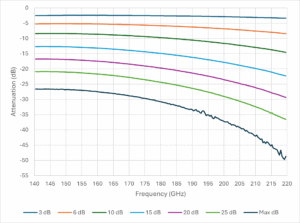 Figure 1a: Traditional linear vane attenuator attenuation performance in WG30 (WR5)
An attenuator’s main functionality is to introduce a known additional loss in the RF system therefore limiting the amount of RF power present. They can be used to add additional path loss to test a device as a variety of power levels, such as an amplifier, or modelling the effects of free space path loss in a communication system. Another use case is an ability to measure the insertion loss of an unknown device by comparing the received power level against a known calibrated variable attenuator.
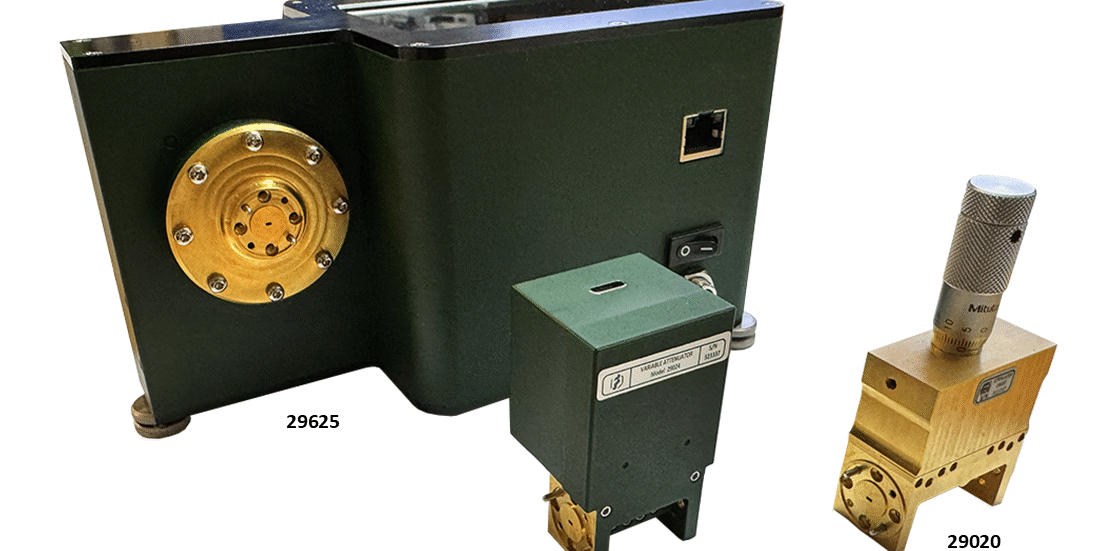
As showcased at IMS 2024 and 2025, Flann have been developing a pioneering style of linear vane attenuator that offers a comparable performance to the traditional RVA at a fraction of the cost size. A linear vane attenuator attenuates the power in the waveguide by introducing a resistive vane into the centre of the waveguide, creating a resistive loss via the currents generated by the E-field in the vane. As the attenuation is caused by a path length effect, traditional designs are very frequency dependant across the waveguide band with higher attenuation levels corresponding to higher frequencies as shown in figure 1b.
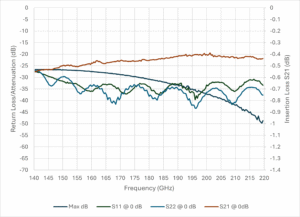
Figure 1b: Traditional linear vane attenuator return loss, insertion loss, and maximum attenuation performance in WG30 (WR5)
Flann’s new linear attenuator design has relied on an electromagnetic field effect that has been exploited using FEM software analysis that has allowed an attenuation variation of less than 10% at 50 dB attenuation across the full waveguide frequency band. An example of Flann’s WG30 (WR5) linear attenuator’s performance is shown in figure 2a and 2b demonstrating its excellent attenuation range across the frequency band whilst offering leading class VSWR and minimal insertion loss.
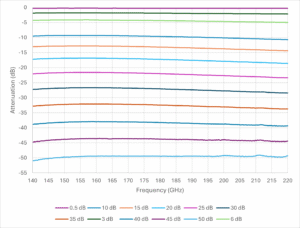 Figure 2a: Flann’s programmable linear vane attenuator measured attenuation performance in WG30 (WR5) showing near RVA levels of performance.
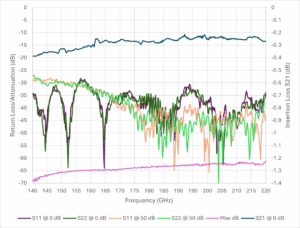 Figure 2b: Flann’s programmable linear vane attenuator measured performance for return loss, insertion loss, and maximum attenuation in WG30 (WR5), showing an improvement in all metrics when compared to the traditional linear vane attenuator.
Alongside our traditional micrometre driven 020 linear attenuator, Flann have developed a programmable version interfaced with a USB port for both power and data transfer, known as the 024 series. While both units offer the same performance and calibration options, the programmable version allows for easier OEM customisation and integration.
Flann’s programmable 024 offers additional advantages over other compact electrically controlled waveguide attenuators, such as PIN diode or ferrite-based designs. Using a high resolution 5 μm actuator with a built-in encoder, the 024 does not need to be powered to stay at the required attenuation and once reconnected it automatically knows its previous attenuation level. Using an electrical loss mechanism Flann’s 024 avoids the magnetic hysteresis memory and reset demagnetization that is found in ferrite-based designs. Both benefits do not hinder the switching speed between attenuation levels, offering a comparable 50 ms performance to the fast PIN diode based attenuators due to the ultra-fast linear actuator.
Conclusion:
In summary, Flann’s latest linear vane attenuator technology bridges the gap between compact form factor and high-performance attenuation control. By leveraging innovative electromagnetic field design and precision actuation, the 020 and 024 series deliver comparable RVA-level flatness with exceptional repeatability, minimal insertion loss, and robust calibration options – all in a fraction of the size and cost. Whether manually operated or fully programmable, these attenuators provide engineers with a reliable, integration-friendly solution for a wide range of RF and millimetre-wave applications, setting a new benchmark for waveguide attenuation performance.